How to Make Money in Movies: A Data-Backed Guide for the Modern Filmmaker
A film is the hardest startup in the world — one shot, no MVP, no soft launch, straight to market. Here is what the numbers actually say about how to make money in movies, and turn a great story into a living.
Every founder dreams of building something people can't ignore. A filmmaker does too — except the filmmaker has to do it without a beta, without a pilot user group, without the luxury of shipping version 1.1 next sprint. The film opens on Friday. The verdict arrives by Sunday. There is no second take with the market.
That single fact — you ship once, fully formed, directly to the public — is why trying to make money in movies has a reputation for being a fool's game. And yet money is made in movies, consistently, by people who treat the craft as both an art and a business.
This piece is about how. Not motivational fluff: the real economics, the real failure points, and the patterns that separate the films that pay for themselves from the thousands that quietly die at the idea stage. We'll use real, current numbers. And because we at Movie Colab build software for filmmakers, we'll be honest about where a tool helps — and just as importantly, where it doesn't.
Part One: The opportunity to make money in movies is bigger than ever
Start with the good news, because it reframes everything. The pessimist's story — "movies are dying, theatres are empty" — is simply false. What's true is that the money moved. It didn't shrink; it multiplied across three distinct pools, and a smart creator who wants to make money in movies can now fish in all three.
The three pools of money in 2025: theatrical box office reached roughly 33 billion dollars globally, up about 8% on 2024. Streaming and OTT brought in over 340 billion dollars globally, heading toward roughly 443 billion by 2029. And the creator economy — short-form, reels, vertical video — was worth around 250 billion dollars, growing about 23% a year.
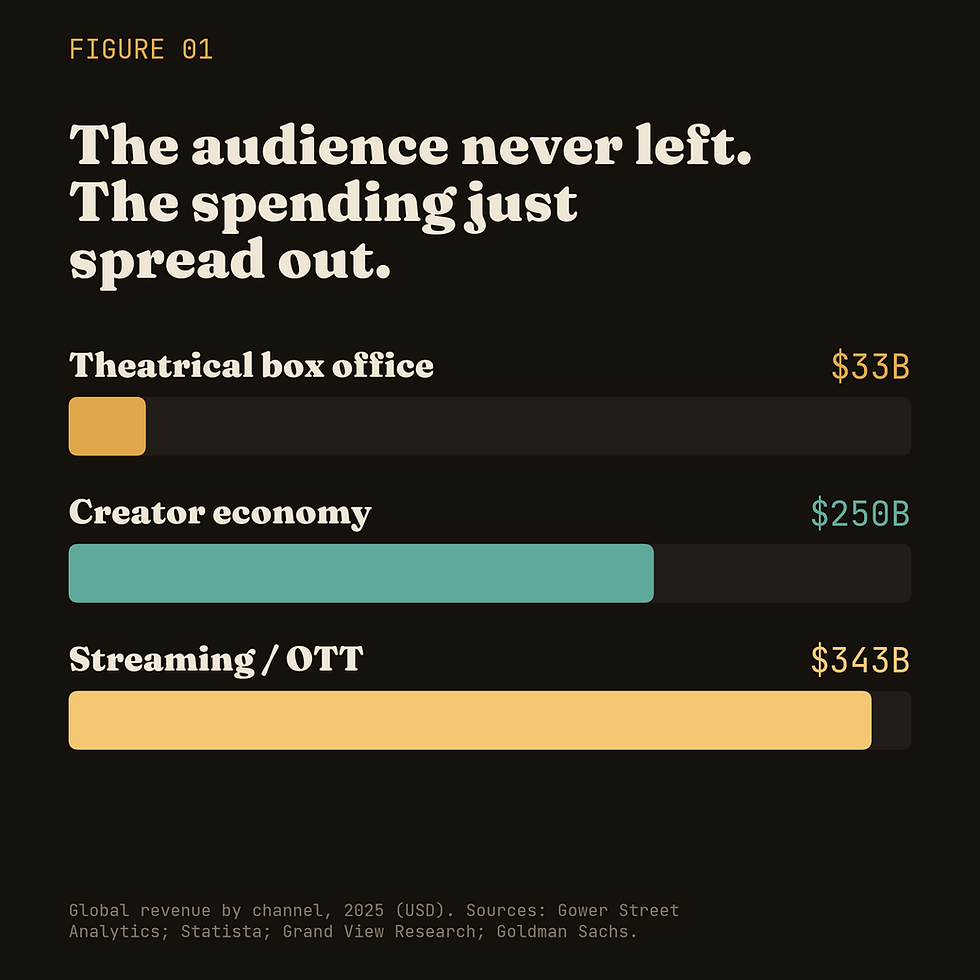
A decade ago, making money in movies meant one thing: a theatrical release. Today, theatrical ($33B) is dwarfed by streaming ($340B+) and rivalled by the creator economy ($250B). The same story instinct that fills a cinema can now fill a feed. You are no longer choosing between art and reach — you are choosing which doors to open, and how many.
And right here at home, the timing is extraordinary
If you're working in India, the wind is at your back. 2025 was the highest-grossing year in the history of Indian cinema — the first to cross ₹13,000 crore (about $1.6 billion), with 37 films passing the ₹100-crore mark, up from 22 the year before. The breakouts weren't only superstar tentpoles. They were rooted, regional, original stories that travelled across languages.
For a creator in Bengaluru, the most important fact in this piece may be this one: Sandalwood — the Kannada industry headquartered in this city — produced one of the best returns on investment in recent Indian film history in 2025. We'll come back to it, because it proves the thesis better than any Hollywood example.
Part Two: Most of the money in movies is made by a few
Now the cold water. A bigger market does not mean an easier one. Film finance is one of the most extreme businesses on earth — a power-law machine where a handful of titles earn nearly everything and the long tail quietly loses.
When analyst Stephen Follows examined a dataset of films with true insider financials, the headline was a near-perfect coin flip: across all of them, roughly half made money and half lost it, for a thin combined profit of about 5%. But the average hides the violence underneath. The top 6% of films generated 49% of all the profit. The bottom 6% accounted for 53% of all the losses. This is not a normal business. It is a lottery with skill — and the skill is in not buying a losing ticket.

Why "it grossed double its budget" still loses money
Here is the trap that sinks first-time producers who set out to make money in movies. The budget you read in the news is the production budget. It almost never includes marketing — known in the trade as P&A (prints and advertising) — which for a wide release often equals or exceeds the cost of making the film. Then cinemas keep roughly half of every ticket. Stack those up and you get the industry's oldest rule of thumb: a film generally has to gross around 2 to 2.5 times its production budget at the box office just to break even.

This is why budget discipline is a creative weapon, not a constraint. A ₹20-crore film needs about ₹50 crore to break even; a ₹100-crore film needs about ₹250 crore — a far rarer event. The smaller you make it, the lower the bar you have to clear, and the more of the upside you keep.
Part Three: The funnel of attrition — where films actually die
If the money is real and the odds are brutal, the obvious question is: where, exactly, do projects fail? The answer is not "at the box office." By the time a film reaches a screen, most of its fate is sealed. Films die — by the thousand — at four earlier gates.
The four gates of filmmaking are simple. Gate 1 is the Story: is it actually worth telling, is it entertaining? This is where most ideas die, silently. Gate 2 is the Team: the right cast, crew, producer and money, aligned behind it. Wrong backers, and the project stalls forever. Gate 3 is the Execution: surviving the chaos of a hundred variables, dozens of artists, no rehearsal. This is where people burn out and budgets overrun. Gate 4 is Marketing and Distribution: the budget's gone, and now you must negotiate the gatekeepers. This is the "valley of death."

Notice that two of the four killer gates — Team and Marketing and Distribution — are business problems, not creative ones. This is the most under-appreciated fact in independent film. Storytellers are rarely natural negotiators or operators. So a brilliant script dies because the wrong producer backed it, or because the money ran out before anyone was hired to sell it. The craft was never the problem.
Gate 4 deserves its nickname
The "valley of death" is real and quantifiable. Recall the most profitable micro-budget films ever made. The Blair Witch Project was shot for tens of thousands of dollars — but its distributor spent 6 to 8 million dollars marketing it. Paranormal Activity cost about 15,000 dollars to shoot; the marketing spend was around 18 million. The films are legends. But the thing that turned them from "a tape no one saw" into a 190-million-dollar phenomenon was a marketing-and-distribution machine — the exact stage where most independents have already spent their last rupee.
Part Four: Story is the highest-leverage way to make money in movies
So what do the survivors share? Strip away the noise and one variable towers over the rest. It isn't budget. It isn't stars. It is a story people can't stop talking about. Word of mouth is the only marketing channel that compounds, costs nothing, and cannot be bought. And the data on micro-budget breakouts is almost unfair.
Consider the return on investment of recent low-budget breakouts. Su From So, a Kannada film from 2025, was made for ₹5.5 crore and earned ₹123 crore — roughly a 22 times return. Lokah Chapter One, a Malayalam film from 2025, was made for ₹30 crore and earned ₹304 crore — about 10 times. The Blair Witch Project, made for around 500,000 dollars finished, earned 248 million — roughly 480 times. Paranormal Activity, made for around 215,000 dollars finished, earned 193 million — roughly 790 times.
Look at Su From So — a Kannada film made for about ₹5.5 crore that earned ₹123 crore worldwide, one of the best returns in recent Indian cinema. No superstar. No franchise. Just a rooted, well-told story that audiences carried on their own shoulders. Meanwhile, in the same year, ₹100-crore-plus tentpoles with mixed reviews still had to fight for every screen. The little film with the better story kept more of its money.
Audiences are not rewarding budget. They are rewarding originality, authenticity, and a story that travels. This is the whole game in one sentence. It is also why writing a great story is not the "fun part before the real work" — it is the work. Everything downstream — the budget you can raise, the team you can attract, the word-of-mouth you'll get for free — is leveraged off the quality of that core.
Part Five: Five questions to answer before you spend a rupee
Principles are easy to nod along to and hard to apply. Here is the honest interrogation every project should survive — the questions a clear-eyed producer asks before committing money to make money in movies.
First, am I actually a good storyteller, or do I just love stories? These are different. Loving cinema is the price of entry; the ability to make an audience feel something on cue is the rare skill. Test it cheaply and often before you scale.
Second, who is my audience, and which pool are they in? "Everyone" is not an audience. Decide early whether this is a theatrical play, an OTT play, or short-form — because the form, length, budget, and break-even math are completely different across the three pools.
Third, can my budget clear the break-even mountain? Take your all-in production cost and multiply by 2.5. Is that box-office number realistic for a film of this kind, with this audience, in these languages? If the honest answer is no, you don't have a financing problem — you have a budget problem. Cut it now, while cutting is free.
Fourth, will I survive the chaos of Gate 3? Filmmaking is a startup that hires its entire workforce for one sprint, in a different location every time, with no repeatable playbook. Most people who quit don't quit on the story — they quit on the coordination.
Fifth, do I have a plan for Gate 4 before the money runs out? Marketing and distribution are not the epilogue; they are half the business. Reserve for them in the budget from day one. The most common way a good film dies is arriving at the valley of death with an empty wallet and no map.
Part Six: Where Movie Colab fits — gate by gate
We'll be plain, because a marketing post that overpromises is exactly the kind of thing this article argues against. No software will write your story. If the concept is weak, no platform on earth will save it — and you've seen the data on what story quality does to returns. A tool is only ever a force multiplier on a strong idea.
But re-read the four gates. Most of them are coordination, craft-feedback, and execution problems — exactly the kind of friction good software removes. The Movie Colab Suite, built by Viga Entertainment Technology, was designed around the entire pipeline, gate by gate, to help filmmakers make money in movies by losing less of it to preventable failure.
Gate 1: The Story
Script Viz turns your script into a visual plan before you spend a single shooting day. Its AI generates shot breakdowns and storyboards in your chosen style, keeps characters consistent with Face Sync, and runs a script analysis with sentiment graphs that map the emotional peaks and valleys of your story. That is the cheapest possible way to test whether the narrative actually works on the page.
Table Read lets you hear your characters before you cast or shoot. Upload the script, assign AI voices, fine-tune the tone, pitch and pace of every line, and listen to whether the dialogue flows and the emotion lands. It is the cheapest possible test of the single most important variable — the story.
Gate 2: The Team
Artist Hub (coming soon) tackles the team gate directly: a curated way to find and hire the right creative talent — VFX artists and production experts — with smart matching, portfolio profiles, and secure international payments. The right team behind a project is one of the four gates films die at; this is built to get it right.
Gate 3: The Execution
Projects is the antidote to the chaos that makes people quit. Every film generates a storm of disconnected information across departments, locations and dozens of artists. Projects pulls it into one customisable mission control — task tracking from In Progress to Approved, a live feed of every new version, and a complete admin audit trail of who did what and when. Its Intelligent Screening Room lets your team leave frame-accurate notes, and its Review Agent reads the whole discussion, summarises the creative direction, and turns it into a clear task list — so no note is ever lost.
Sync Space kills the version-conflict problem that quietly bleeds money on every modern production. It keeps project files organised, locked against overwrites, and consistently versioned across a hybrid studio — a single digital source of truth that survives the move from one project to the next.
Movie Colab VR brings the ten-million-dollar screening-room experience to any creator. Step into a private virtual theatre — now supporting 2D and 3D IMAX, live on Meta Quest — where your whole team watches in synchronised playback, annotates the screen in 3D space, and has every spoken note automatically transcribed, time-coded and synced back to your project. It surfaces the expensive problems before they cost a crew day.
The honest economic argument
Here it is, and it's a modest one on purpose: every rupee of friction removed before the shoot is the cheapest money in the entire production. A story flaw caught in a Table Read or a Script Viz sentiment graph costs nothing. The same flaw caught in the edit costs a re-shoot. Caught at the box office, it costs the whole film.
Movie Colab doesn't promise you a hit — nothing honest could. What it promises is to stop good films from dying of preventable causes, at the exact gates where preventable causes do the most damage. The data says story quality and process discipline separate the winners from the long tail. We can't give you the first. We are built to give you the second — and to make protecting the first dramatically cheaper.
Make the odds work for you
The market has never been bigger. The craft has never been more leveraged. The chaos is the only thing standing between a great story and a living. That's the part we built for. Explore the Movie Colab Suite at www.moviecolab.com.
A note on the numbers. Theatrical box office: Gower Street Analytics. Streaming and OTT: Statista OTT Video outlook. Creator economy: Grand View Research and Goldman Sachs estimates. India box office: Ormax and industry reporting. Profitability, the 50:50 rule and the break-even rule: Stephen Follows' analyses of insider film-finance data. Micro-budget marketing spend: The Hollywood Reporter and trade reporting. All figures are revenue unless stated; profit is a different and harder number.


Comments